

Basics: Understanding the A.TR
What is an A.TR movement certificate?
The A.TR movement certificate is a formal customs document for the movement of goods between the European Union and Turkey. The A.TR is used for so-called customs union goods and accompanies shipments of goods that are eligible for duty-free import.
Is the A.TR a proof of origin?
No. Even though the A.TR enables customs benefits in the movement of goods between the EU and Turkey, it is not a proof of origin. This means it does not certify that a good originates in the EU or Turkey. Instead, it certifies that the good is in free circulation in the exporting country.
What is the difference between the A.TR and the EUR.1?
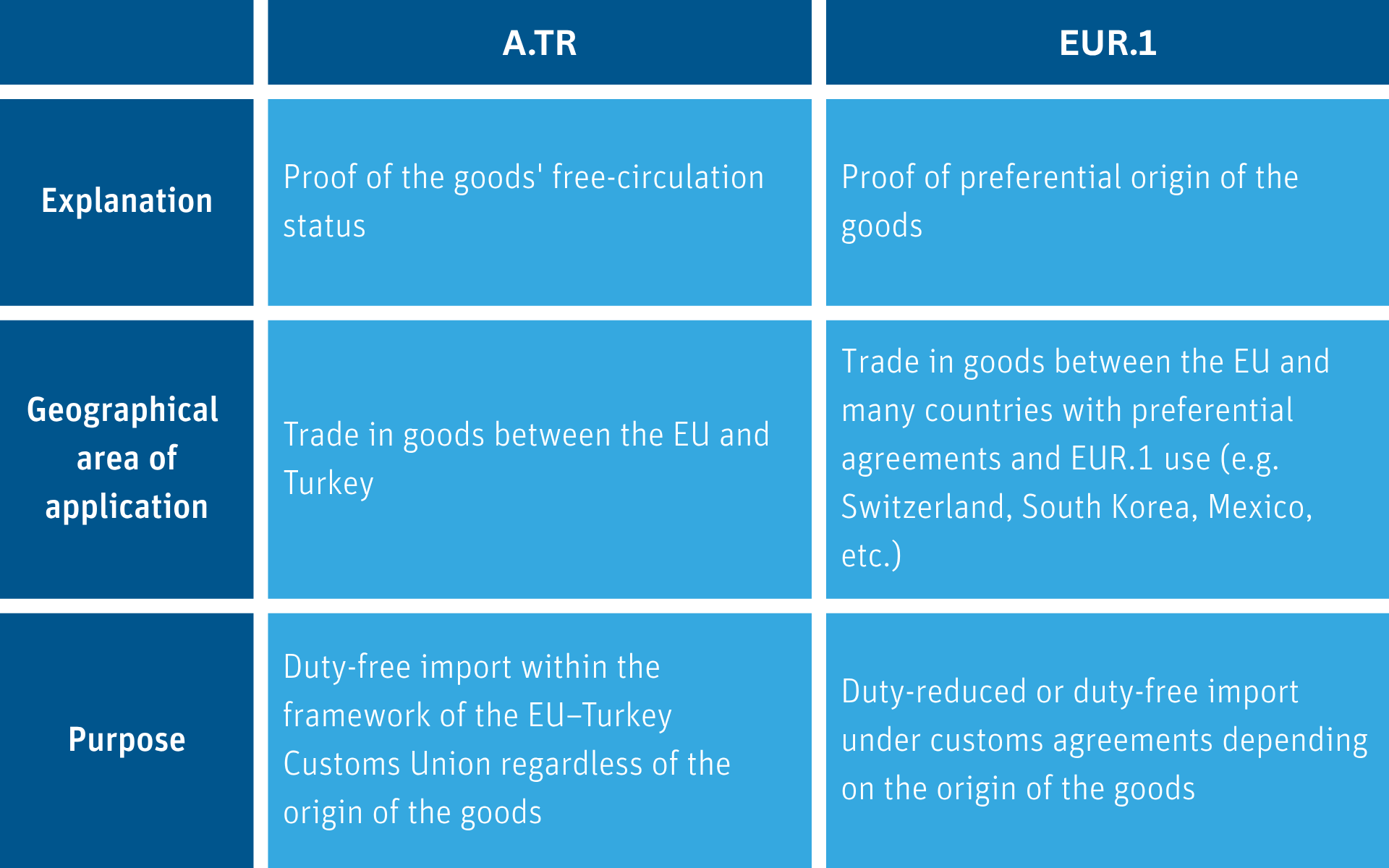
Both the A.TR and the EUR.1 are movement certificates, but they serve different customs purposes. The A.TR certifies that goods are in free circulation, while the EUR.1 certifies the preferential origin of goods.
Comparison of the A.TR and the EUR.1:
For which goods can an A.TR be used?
In principle, the A.TR can be used for almost all commercial or industrial goods traded between the EU and Turkey. There is no de minimis threshold. This means that an A.TR can also be relevant for shipments with a low value.
Exceptions apply in particular to certain product categories. These include agricultural products as well as certain iron and steel products falling under the ECSC product group. For these goods, other proofs of origin, such as an EUR.1 or a declaration of origin, may be required instead.
In addition, Turkey’s trade policy measures may apply to certain goods. In such cases, a certificate of origin may be required in addition to the A.TR.
Who can use an A.TR?
In principle, any exporter or their representative can use an A.TR movement certificate for duty-free import into the EU or Turkey. There are no specific requirements regarding the exporter.
However, having “Approved Exporter” status simplifies the process: Companies with the appropriate authorization can have A.TR forms pre-stamped through a simplified procedure.
Should I / Can I use an A.TR?
Whether an A.TR is suitable for your shipment can be determined based on a few key criteria. Here is your checklist for self-assessment:
- EU–Turkey trade: The goods are being transported between an EU member state and Turkey, or vice versa.
- Free circulation status: Prior to export, the goods are in free circulation under customs law in the country of export.
- Eligible goods:
- The goods are generally commercial or industrial in nature.
- Furthermore, the goods are not among those excluded from the A.TR. (e.g., agricultural products or certain iron and steel products from the EKGS product group).
- For third-country goods: The goods have been fully cleared through customs and all applicable taxes have been paid.
- Transportation: The goods are transported directly. Transit through third countries is permitted provided the shipment remains under customs supervision and, in principle, is only transshipped, temporarily stored, or treated to preserve its condition while there.
- Evidence: The required information and documents regarding the status of the goods can be provided.
How do you apply for an A.TR movement certificate?
The A.TR is generally applied for and certified at the competent customs office of the exporting country. The exporter provides the required information; the customs office reviews the document and certifies it.
Information for Exporting Goods with an A.TR from Germany to Turkey (under the standard procedure—special regulations for authorized exporters may apply):
What information and documents are required? (Standard procedure)
- A fully completed A.TR form (available from form suppliers or at the local Chamber of Commerce and Industry)
- Proof that the goods are in free circulation
- If indicated in Field 10 of the A.TR application: Commercial invoice with a precise description of the goods (or alternative)
How is the A.TR form filled out correctly? (Standard procedure)
- Field 1: Name and address of the exporter
- Field 2:(optional): Transport document number
- Field 3: (optional): Name and address of the consignee
- Field 5: Country of export: “Germany”
- Field 6: Country of destination: “Turkey” / “Türkiye”
- Field 7 (optional): Mode of transport (e.g., truck, ship, air freight)
- Field 8: Remarks (e.g., “issued retrospectively”)
- Field 9: Sequential numbering of the commodity items listed in Field 10
- Field 10: Description of goods (or reference to an attached document containing the description of goods) with details on packages; void any unused space in Field 10
- Field 11: Gross weight in standard commercial units of measurement
- Field 12: Master Reference Number (MRN) of the export shipment
- Field 13: Place, date, signature, and name of the exporter or their representative (if represented: the nature of the representation must be specified)
Note: An entry is already pre-filled in Field 4 of the application form—exporters do not need to enter anything here.
Where is the A.TR certificate applied for? (Standard Procedure)
The A.TR movement certificate is submitted to the customs office responsible for the export procedure.
You can obtain the forms in advance either from your local Chamber of Industry and Commerce (IHK) or at a standard office supply store.
How does shipping to Turkey with an A.TR work?
Under the standard procedure:
- ATLAS export declaration: The exporter declares the export in ATLAS and receives a unique MRN for the export transaction.
- Apply for the A.TR: The exporter applies for the movement certificate at the competent customs office.
- Have the A.TR certified: The customs office reviews and certifies the document.
- Forward the A.TR & ship the goods: The goods are transported to Turkey. The A.TR is handed over to the importer.
- Presenting the A.TR: Upon import, the A.TR is presented to the competent customs office in accordance with the applicable procedural regulations.
FAQ: Frequently Asked Questions & Answers About the A.TR Movement Certificate
Do the goods have to come from the EU?
How much does an A.TR cost?
Can an A.TR certificate be issued retroactively?
- Late issuance of an A.TR certificate due to an error, an oversight through no fault of the exporter, or special circumstances
- Rejection of the A.TR certificate upon import due to formal errors
The retroactive application must be submitted to the customs office responsible for the exporter, stating the reason. The A.TR is then marked in Field 8 as “issued retroactively”
How long is an A.TR valid?
Conclusion
The A.TR Certificate of Movement of Goods is a key document for the movement of goods between the EU and Turkey. It allows for duty-free imports under the terms of the customs union. By submitting an application in a timely manner using the correct forms, exporters can thus secure customs benefits for their trading partners.